
Oregon’s public pension investments had a good biennium, but many school districts will still be facing huge increases.
Milliman, Oregon’s actuary, released its PERS investment valuations last week in preparation for the PERS Board meeting on Friday, July 24.
On the whole, the system’s assets outperformed the assumed rate of return, decreasing PERS unfunded liability by roughly $2.6 billion in 2025. Unfunded liability is the amount PERS is short of the total benefits currently promised to workers and retirees. It’s a main factor in persistently high school district PERS rates.
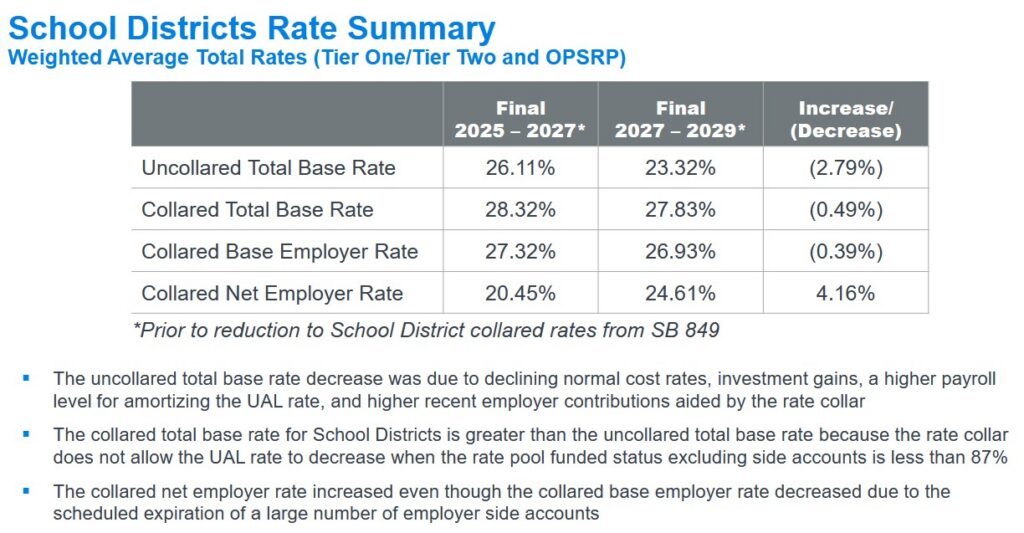
Despite PERS’ improved financial status, the net school district rate will increase an average of 4.16 percentage points to 24.61%. Nobody pays the average, though, with actual rates varying from practically nothing to nearly a third of payroll.
A school district’s rate depends on its payroll and staff demographics and whether it has a side account, which is an additional payment made by an employer usually using bond proceeds from when interest rates were more favorable. For more than two decades, side account investments have helped offset rates for many but not all school districts. However, most of the side accounts are expiring by 2027.
In 2025, districts with side accounts saw an average 2.56 percentage point increase in their PERS rates as their investments wound down. But because of the variability of districts’ liability, some districts saw their rates more than double. Although they had lower rates than districts without side accounts, the sudden increase created budget distress.
The side account offset for schools has plunged from an average of 10.77% in 2023-25 to 2.32% in 2027-29, according to Milliman. Districts seeing the end of their side accounts can expect more big increases when individual employer rates come out in late September. Individual employer contribution rates will be presented to the PERS Board for approval at its Sept. 25 meeting.
Meanwhile, the average collared base rate will actually decrease a fraction of a percentage point to 26.93%.
PERS uses a “rate collar.” It keeps rates from skyrocketing in bad years, and it keeps the uncollared base rate from decreasing until the funded status for the rate pool excluding side accounts is greater than 87%. PERS’ funded status increased to 76% at the end of 2025, up from 73% at the end of 2024.
All told, school districts are forecast to pay $2.94 billion into the PERS system in 2027-29, an increase of $630 million.
Some of that will be paid directly by the state, thanks to legislative action prompted by education advocates. Senate Bill 849 (2025) dedicated an unused pot of money to PERS, lowering school district rates by 1.68 percentage points in 2025-27.
It was supposed to be a one-time deal, but the pot unexpectedly will receive what is now supposed to be the last deposit. Milliman projects a second use of SB 849 will reduce school district rates by 1.37 percentage points, but the exact figure will be calculated in early 2027.
– Jake Arnold, OSBA
[email protected]