

Happy mothers take important first day of school pictures at Rural Dell Elementary in the Molalla River School District on Monday, Aug. 31. Students and teachers will be tackling new curricula, an annual ritual all over the state. (Photo by Jake Arnold, OSBA)
Many Oregon schools will be launching a new social studies curriculum this year as they open their doors in late August and early September.
Students are unlikely to notice, but educators, administrators and school board members have been discussing, planning and budgeting for the new books and materials for at least a year. Those discussions included nuanced decisions about trade-offs.
“Curriculum is one of the hardest things to budget for individually,” said Jackie Olsen, Oregon Association of School Business Officials executive director. “It’s really hard to say we have to cut a teacher because we have to buy math books this year.”
School finances are a tangled series of spending choices, where every move ripples through the budget. OSBA is exploring the interlocking revenues and costs in the OREdNews series Oregon’s Education Equation. The desire of families, schools and legislators to put the best curriculum in students’ hands often crashes into tight budgets and shifting standards.
Curriculum choices are high-stakes decisions as they usually include seven-year contracts. If a district gets it wrong or must change direction because of new rules, it can cost significant budget money.
Dayna Cahill, the North Bend School District director of teaching and learning, defines curriculum as everything a student is exposed to as well as everything the student is not exposed to. Choices about what a student will and will not see determine the learning, he said.
Cahill pointed to how curricula handle the Native American experience, nationally and in Oregon, for instance. The district is starting a new health curriculum this year, another area where what is and is not taught comes under intense scrutiny.
Oregon school districts are generally updating about one curriculum subject a year for all grades, if budget and local circumstances allow. The Oregon Department of Education currently has a seven-year schedule to review instruction materials in nine subject areas. Districts are required to adopt new curriculum every seven years or apply for up to a two-year waiver.
This school year, new social studies standards are coming to the classroom, and earlier this year the State Board of Education adopted English language arts and literacy standards to be implemented in 2028-29.
ODE takes about a year to develop a subject’s curriculum standards, which then must be approved by the State Board of Education. The Legislature, though, sometimes adds to the criteria. For example:
Senate Bill 13 (2017) required a K-12 Native American curriculum for Oregon students that meshes with all the core subjects.
House Bill 2166 (2021) required the State Board of Education to adopt social and emotional learning standards by 2023. Schools had to implement these across all content.
Senate Bill 3 (2023) added two half-credits required for graduation on personal finance and post-high school skills. The credits will be required this school year, meaning new curriculum is needed.
Standards can be changed nationally, as well. ODE is monitoring an ongoing review by the National Coalition for Arts Standards.
Once the state board approves the standards, ODE prepares a list of “high-quality instructional materials.” The State Board of Education must approve the list. Some subjects, such as math, might have a half-dozen or more options with a range of costs, while other subjects, such as health, might have one or two.
Schools are required to adopt high-quality instructional materials, but districts can select options not included on ODE’s list as long as they meet Oregon content criteria.
Curriculum budgeting is a waterfall of decision-making. The base curriculum costs for the same subject can range from less than $20 to more than $200 a student depending on the publisher and the subject. That’s just the start, though. Does a district want workbooks for elementary students, physical textbooks or digital links, extra materials for activities, or language translations?
Curriculum costs include things such as digital subscriptions, kits for science experiments, physical education materials and teachers’ books. It also means training and ongoing professional development for teachers.
Teachers typically receive at minimum an initial training on new curriculum at the start of the year and a follow-up training several months in to answer questions and refine methods. For elementary educators who teach multiple subjects, they may need to be learning new curriculum just about every year.
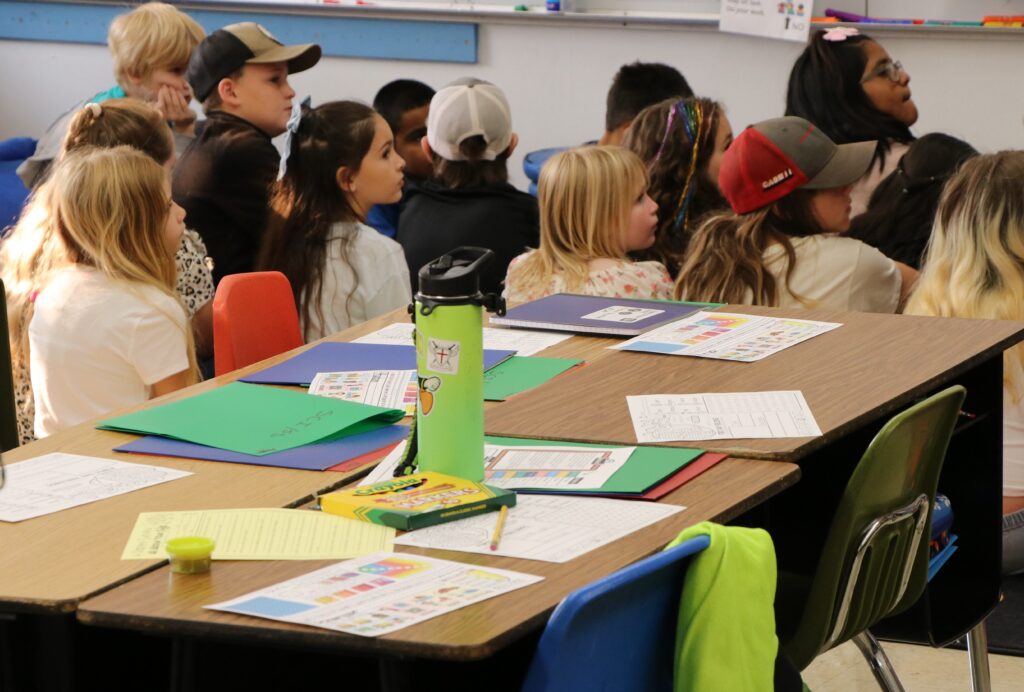
Curriculum costs include all sorts of materials for students as well as building teacher expertise to guide students through the lessons. (Photo by Jake Arnold, OSBA)
All this training requires time that a district must account for in its calendar and contracts with teachers. It also calls for substitute teachers if it happens during the school day. The minimum required day rate for substitute teachers is $236.26, according to ODE.
Andy Campbell, the Molalla River School District chief financial officer, estimates the district averages about $250,000 a year in curriculum costs. For larger districts, the costs can run into the millions.
Curriculum costs vary widely from year to year though.
Cahill of North Bend said recent costs for his district, not including staff training, ranged from $80,000 for K-8 health curriculum to $220,000 for K-5 reading. He said his district is looking at holding onto existing reading curriculum partly to save money.
ODE has tried to reduce the financial pain by spreading out the adoption years for the subjects with the biggest costs: math, science and English language arts.
ODE is proposing to the state board to go a step farther by lengthening the cycle to nine years for English language arts, English language proficiency, mathematics, science, health and social sciences. ODE would offer a flexible support model for physical education, world languages and the arts with locally decided adoption timelines.
Vanessa Martinez, ODE director of standards and support, said they know it’s hard for districts to change a curriculum every year and that cost is a factor. There is also the matter of training teachers, which takes time and money.
“It can’t just be here are the materials, unwrap the shrink wrap and there you go,” Martinez said.
Budget calculations can create some complicated decisions.
The Molalla School District adopted a new social studies curriculum for K-5 and eighth grade while continuing what was adopted seven years ago for the other grades. But it is using a different publisher for fourth grade.
Tamara Jackson, Molalla River director of teaching and learning, said the new curriculum addresses the changes in state standards while the renewed curriculum was already addressing those standards.
Campbell, the Molalla River CFO, typically gives a curriculum budget range to Jackson, who then figures out which curriculum options would fit in the budget.
Jackson gives those options to an adoption committee to kick the tires. A committee is made up of teachers from all the buildings as well as representatives from areas such as special education and talented and gifted and maybe a topic area consultant from the Clackamas Education Service District. The committee reviews state standards, surveys staff and students, looks at district data for strengths and needs, checks out materials and runs pilot lessons with some of the curriculum.
The adoption committee mostly meets after school, meaning extra staff time. If it meets during school hours, the district must pay for subs for the teachers.
The adoption committee must put its recommendation out for public comment and take it to the school board for approval.
Jackson estimates the science curriculum the district launched last school year cost close to $500,000 for seven years, including staff time.
“It’s real important to plan which curriculum adoptions you want in the future,” she said. “If you haven’t planned for it, it’s hard to do those years.”
Rebecca Wilson, a Molalla River third and fourth grade teacher, was on the social studies adoption committee. She said they chose a different publisher for fourth grade because it was better about Oregon but they couldn’t afford that publisher for all grades.
She said one curriculum had features everyone on the committee liked but it was almost triple the price. When the committee was split on a curriculum, money was usually the tiebreaker, she said.
In the end, though, Wilson said she is excited about the curriculum they landed on.
“We are fortunate the budget and what we wanted to do worked,” she said, “I’m not sure what would have been done if it didn’t.”
– Jake Arnold, OSBA
[email protected]
Previous Oregon’s Education Equation stories