
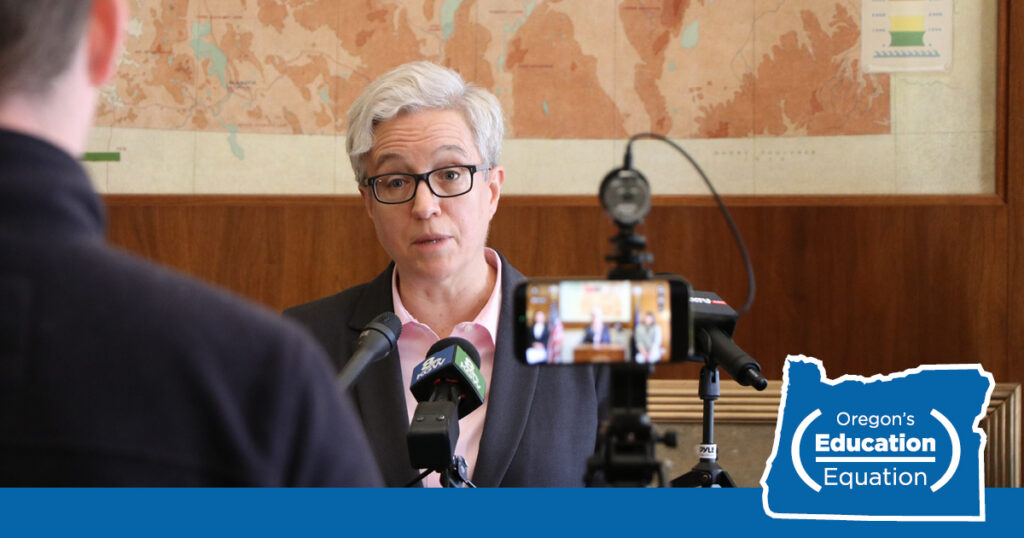
Gov. Tina Kotek announced an executive order aimed at preserving schools’ instructional time. School leaders say the order didn’t factor in logistical and financial issues. (Photo by Jake Arnold, OSBA)
The Canby School District did not decide on furlough days lightly.
In 2025, the district cut 74 full-time equivalent staff positions out of 514 FTE to fill a $7 million shortfall for this school year. But the bills kept growing, and the district is facing a $6.3 million shortfall for 2026-27.
The district announced in April the layoff of an additional 60 staff (almost 50 FTE) and deep cuts to programs, including career and technical education, reading supports, counseling, music, arts and athletics. District leaders chose as well to cut the school calendar this year and next to avoid deeper cuts to staff and programs.
“The decision the union and the board made for furloughs days was a last resort – simply a last resort – for our children,” said Canby Superintendent Jennifer Patterson. “All of this is absolutely heartbreaking.”
School instructional time has been the focus of intense attention lately by the governor, the State Board of Education and education advocates, but the concern isn’t new. Oregonians have been worrying about the state’s short school year for decades.
In 2018, Gov. Kate Brown directed the Oregon Department of Education to convene a workgroup of more than 50 key education stakeholders and make recommendations for increasing Oregon’s instructional time. Everyone agreed they would like students to have more time in school, but the final report showed the solutions to be more nuanced than simply adding days to a calendar. The report raised concerns about quality of time and feasibility of implementation that remain valid and unaddressed.
School district finances are wildly complicated, with dozens of sources of interlocking income and expenses that are mostly out of school leaders’ control. Through the rest of the year, the OREdNews series “Oregon’s Education Equation” will be taking a deeper look at important aspects of school district finances. How long students spend in school touches every element of the budget.
In the face of costs outrunning state funding, the Canby superintendent and school board had to weigh calendar days against the quality of students’ time in school.
The district has little control over cost drivers. The district’s Public Employees Retirement System rates more than doubled for 2025-27 because of the winding down of its side account. New laws from the Legislature such as paid leave requirements have added new expenses without additional funding. Legally required special education expenses continue to outstrip state and federal funding. And everywhere inflation was pushing up costs, especially for insurance and labor.
Like with districts all over Oregon, Canby is also losing state funding as its enrollment shrinks because of demographic changes. But it’s losing staffing faster. Canby enrollment has dropped 14% since 2019 but it’s cut roughly 25% of its staff in just the past two years, Patterson said.
Eight days of furlough – four this school year and four next – would amount to about a 2% pay cut for staff and save the district $1 million.
Patterson spent long hours talking with the district’s unions, families and school board about what core programs and services needed to be protected. The furlough days offered a way to keep some educators and any programs or services that came along with them.
On April 13, the school board approved the furlough plan. Three days later, Gov. Tina Kotek announced an executive order forbidding school districts from using furlough days to balance their budgets. Districts that had already cut instructional time must make it up by the start of the 2027-28 school year even if, like Canby, they are still above the state’s required minimums.
Kotek said at a news conference she had to act immediately to protect instructional time because a half-dozen districts had recently announced furlough days. More than a dozen additional districts have publicly announced budget shortfalls, ranging from Oregon’s largest such as Portland, Beaverton, Salem-Keizer and Eugene to medium and smaller districts such as South Lane, Oregon City, Lincoln County, Lebanon and Sisters.
Patterson said her district is affected by forces obviously larger than local decisions.
“This is clearly not a Canby problem; this is a statewide problem,” she said. “Problems of this scope and scale require a lot of collective listening, collective inquiry and collective problem solving.”
OSBA Executive Director Emielle Nischik said Oregon needs to look for systemic answers informed by local perspectives such as Canby’s.
“When we constantly chase the issue of the day – class size, graduation requirements, accountability, early learning, summer learning, instructional time – and never look at the whole picture, schools get pulled in 50 directions and go nowhere,” she said. “Simple answers and quick fixes won’t solve this complex and decades-old problem.”
Nischik recently sent a statement to school board members expressing her frustration with the state not giving multiple initiatives over the years time to work, such as the Student Success Act, the Early Literacy Success Initiative and the Education Accountability Act.
“People who understand Oregon education did the work in 2018 to study instructional time and then that report was put on a shelf,” she said. “Now we are back talking about instructional time without having done the real work of implementing meaningful change.”
OSBA and its education partners are preparing for the next legislative session by working together to find whole-system, research-backed approaches to lifting student achievement, Nischik said.
On a gut level, requiring more instructional time feels like the answer to Oregon’s poor test results. But the 2019 ODE report found that a meaningful “instructional time” requirement calls for a lot more than just counting hours.
Oregon law requires 900 hours of “instructional time” in K-8, 990 hours for grades 9-11 and 966 hours for grade 12. It counts hours students are engaged in planned educational activities or assessments. It does not include such things as passing times or meal periods, and it counts only a limited amount of recess for grades 1-3. In practice, that tends to translate into around 165-170 actual days of school.
Most states that require minimum school time average around 180 days, but definitions of what counts as a school day or hour often include noninstructional time.
The report noted Oregon’s lower hourly total was partly a function of it focusing on only time when learning or testing was taking place. The report said Oregon’s use of hours instead of days allowed schools more flexibility in their calendars to address scheduling challenges.
The report also said that any big changes would require a significant roll-out period to adjust school calendars and staff contracts.
Kotek’s executive order seemed to pay little heed to ODE’s prior work, with the order taking effect immediately, Nischik said. State Board of Education members raised similar concerns while working on the rules for Kotek’s order.
Oregon rules allow school districts to count up to 30 hours of staff professional development and up to 30 hours of parent-teacher conferences toward the time requirement. The executive order prohibited districts from counting those hours as instructional time.
Superintendents counter that those hours are crucial to public education and can’t just be dropped. Much of the professional development time is state-required training, and parent engagement is a stated focus for Oregon education.
The State Board of Education has not yet created rules to address that part of the governor’s order. Nischik said she hopes the ODE report from 2019 will influence rule-making.
State rules require districts to report to ODE whether they met Oregon’s minimum time requirement, but they are not required to report how many hours they offered. The governor’s order says schools must start tracking and publishing instructional hours, but the order further confused the issue by defining the time differently than current regulations
Kotek’s order prohibited reducing “student instructional time,” newly defined as the total bell-to-bell hours students are in school. ODE sent out a survey recently to ask districts how much time they offer under the state’s definition and the governor’s definition.
Heidi Sipe has been Umatilla School District’s superintendent since 2007 and said her calendar has largely been unchanged in that time. Sipe said focusing on quantity rather than quality of instructional time misses the real picture.
It’s pointless to add days unless students have reasonable class sizes and well-rounded education options and teachers are well-trained and well-informed by parents, Sipe said. For her, lowering class sizes, adding extracurriculars and increasing mental health support are more valuable budget goals than adding days.
There is also the matter of paying for additional time.
Jackie Olsen, the Oregon Association of School Business Officials executive director, roughly estimated an Oregon day of school costs around $40 million. Without additional state money, Olsen said, districts would have to cut staff numbers or reduce existing staff’s pay rate to add significant time.
She also said any change to the calendar, whether adding hours or changing professional development and conference time, would likely require reopening every school union contract in the state.
The 2019 ODE report concluded Oregon would do better with locally targeted investments to raise the quality of instruction time than with a broad mandate to increase time.
“At an anticipated cost of over $500 million per biennium to implement a 180-day year for all districts, participants did not think a universal new requirement would be the best return on investment,” the report said.
Sipe said the state funding would also have to be consistent and reliable before she could change her budget to add roughly $100,000 a day for her district.
Canby School Board Chair Sara Magenheimer said the governor’s order was really frustrating and “diminishing” because the district did not decide on furloughs quickly.
“It was truly a last resort,” she said. “We looked at all the options on the table last year and didn’t pick that one up. This year, we felt we had no choice.”
Canby has a levy on the May 19 ballot that would provide $5.9 million a year for five years. District leaders hope a successful levy will allow it to hire back much of the staff, but the budget and union contract timelines required it to announce the layoffs and furloughs in April.
Magenheimer said the board is using every tool at its disposal while looking at the broader picture of children’s whole education. Furloughs were just one of part of the equation.
“We know it’s not best for kids, but what is also not best for kids is having 30 kids in a kindergarten classroom and cutting music and arts and having no counselor,” she said. “The entire budget picture is absolutely not best for kids.”
– Jake Arnold, OSBA
[email protected]