
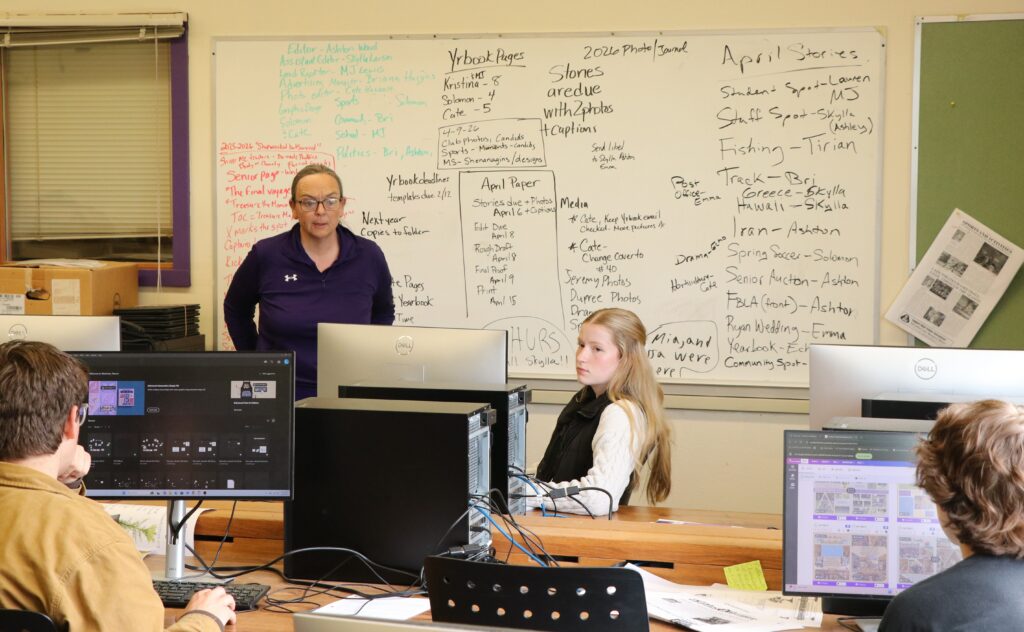
Teacher Amanda Carlton and sophomore Brianna Huggins lead an editorial discussion as the Pacific High School newspaper and yearbook class prepares to put out the April print edition of The Jolly Roger newspaper. (Photo by Jake Arnold, OSBA)
With 11 students taking Pacific High School’s newspaper and yearbook class, The Jolly Roger’s staff size dwarfs that of most small-town newspapers. Not bad for a high school with just 62 students.
The monthly print newspaper has become an important community source of information. When a Feb. 2 shooting in Port Orford locked the school down the day before deadline, student reporter Brianna Huggins knew she had to get to work gathering information and writing a story because people were asking.
“Being part of one of the most cool things our school does is really important to me,” said Huggins, a sophomore reporter.
The Port Orford-Langlois School District on the southern Oregon coast has tapped into an old-school media form to meet the modern challenge of engaging students.
Real-world, hands-on classes are a proven means of encouraging student attendance and academic engagement. But Oregon’s smallest school districts face the twin challenges of having enough student interest to make a class worth the time and finding someone on staff or in the community who can teach it in addition to whatever other jobs they have.
Port Orford-Langlois found a winner by listening to students. When students asked why the high school didn’t have a newspaper, Amanda Carlton added journalism adviser to her other teacher, adviser and coach hats. Carlton, the grades 7-12 social studies teacher, worked at a newspaper for 10 years before becoming a teacher.
The Jolly Roger launched in the 2024-25 school year with help from Matt Hall, owner and editor of the Port Orford News, Curry County Reporter, Coquille Valley Sentinel and Myrtle Point Herald.
Hall connected the high school with the printing plant he uses in Klamath Falls and helped them negotiate a good printing price. He also picks up their newspapers from the plant five hours away when he gets his own, saving the school hundreds of dollars in logistics.
The paper costs about $500 an issue to print, with some of that offset by paid advertisements in the paper as well as community donations, according to Carlton.
Hall said The Jolly Roger may offer him some advertisement dollars competition but he wants to support young journalists.
“I’m so proud of them I could bust,” he said.
The eight-page broadsheet comes out eight times a school year, roughly once a month, an ambitious publishing schedule for a school newspaper. In addition to the school, The Jolly Roger’s 500 copies are distributed for free to the community’s library, markets and restaurants.
“It’s impressive what these kids are doing,” Carlton said. “A lot of members in our community say it’s one of the most mistake-free papers they’ve ever seen, and that’s because we have 11 sets of eyeballs on it.”
Superintendent Aaron Miller said district staff are constantly trying to figure out ways to add electives that excite students. The journalism class ticks important boxes.
“It has real-world relevant opportunities,” he said. “It engages kids. They are interested. They are learning. They are getting out of it what they need. They have an instructor who has newspaper experience and that adds credibility.”
Adding more credibility, Carlton was named the 2026 Oregon Journalism Education Association Rookie Adviser of the Year.
The class is open to all grades, and students can take it multiple times for credit. Students said the class serves more than those interested in journalism.
Echo Johnson, a freshman reporter, said the writing and editing are helping with her English class. Kristina Sichting, a sophomore assistant yearbook editor, said the class is teaching her to plan better and how to communicate with people to get what she needs. Mason Cassady, a junior, is learning practical computer skills.
Huggins, who will be editor next year, said the paper helps students who aren’t into sports or clubs feel like they belong to the school. She said it gets students reading because they want to know what is going on or just see their name in print.
Miller said the class also allows students a chance to earn some recognition for college applications.
At the Fall Media Day in November in Eugene, The Jolly Roger earned Best in Show Small School Newspaper, and five of its writers earned recognition.
At the Spring Media Day in Portland, Pacific High School competed against newspaper programs that have nearly as many students as Pacific’s entire enrollment. The Jolly Roger’s staff earned multiple awards for writing and photography. Editor Ashton Wood was named second team all-state.
Wood, a senior who is considering a career involving writing, said the class shows that school staff really care about what students want. It’s also been thrilling for him.
Wood was able to interview Sen. Jeff Merkley on Jan. 26 at a town hall meeting.
“A name you hear on TV – to actually ask him questions on camera was a cool experience,” he said.
The paper’s articles can run from explanations of the Epstein files scandal to critiques of the Super Bowl performances as well as local news about fishing or the new crane on the dock.
“It’s about reporting the truth,” Carlton said. “As a social studies teacher, I want kids to know about current events.”
The paper also delves into the everyday matters of student life, such as a criticism of school lunches in the second issue. Miller said that article didn’t have all the facts but it led to some good conversations about the responsibility to get things right.
Miller reviews the paper before publication, but he gives Carlton and the students lots of autonomy.
School board member Carol Hacerl appreciates that student voice. She calls the paper a window into the school, showing where the school board needs to do work and showing off where the students and school are succeeding.
Hacerl said she is impressed with the professionalism of a product that still feels student driven.
“I’m amazed this could come out of such a small school,” she said. “I know that perfection doesn’t just happen.”
– Jake Arnold, OSBA
[email protected]