Decades ago, political leaders decided to give public employees generous pensions instead of bigger raises, kicking the fiscal responsibility down the road.
After the costs started to mount, Oregon leaders sobered up and the Legislature dialed back Public Employees Retirement System benefits. But it was too late, and costs continued to climb. A stock market crash in 2008 and a court ruling in 2015 turbocharged PERS rates, and education advocates have been sounding the alarm for more than a decade.
The PERS Board will meet Friday, Sept. 25, to adopt individual employer rates, including for school districts. More than 100 school districts and education service districts with expiring side accounts are looking at sizeable rate increases, with a few going from zero to more than 27%.
Oregon has promised school workers a good pension. School employees, retired and still working, have earned contractual benefits, and districts are obligated to pay them.
“We prioritize paying people after they are out of public service rather than while they are providing services,” said Carol Samuels, Piper Sandler & Co. managing director and longtime adviser to school districts on PERS issues.
To meet those promises, school districts will spend roughly one-fifth of the State School Fund in 2025-27 on PERS. For 2027-29, the total cost will be an estimated $2.94 billion, a $630 million increase from 2025-27, according to Milliman, Oregon’s actuary.
Those payments are not just going into current classrooms, though. Almost 70% of PERS’ liabilities is for people no longer working or no longer in a PERS-eligible job, as of 2024.
High PERS costs have enormous implications for what school districts can do with their budgets. Oregon’s Education Equation, an ongoing series from OREdNews, is examining forces such as this that are shaping schools’ finances. PERS is one of the biggest single costs for most districts, and yet they have almost no say.
The Legislature sets the pension benefits, the PERS Board makes decisions that affect the rates and school districts foot the bill.
“This is a state program which compels local government participation,” said Jordan Ely, Northwest Regional Education Service District chief financial officer and Oregon Association of School Business Officials board president. “A state board makes all of the decisions, but as of yet, local governments are liable for the consequences of that board’s decisions.”
Complicated Shadows
PERS is the second-most complicated public pension system in the country, according to PERS reports, so figuring out what districts owe becomes wildly convoluted quickly.
Start by knowing that PERS covers most public employees. PERS reports break out numbers for school and education service districts separately because of some calculations unique to them, but they share some obligations with the rest of the system.
PERS’ easiest equation is that Benefits = Contributions + Earnings.
PERS’ investment earnings aren’t enough to cover benefits, and the difference must be made up with contributions from school districts. Currently, about 73% of benefits are paid by earnings.
Figuring out an employer’s contribution to cover the rest is where the weeds start getting tall.
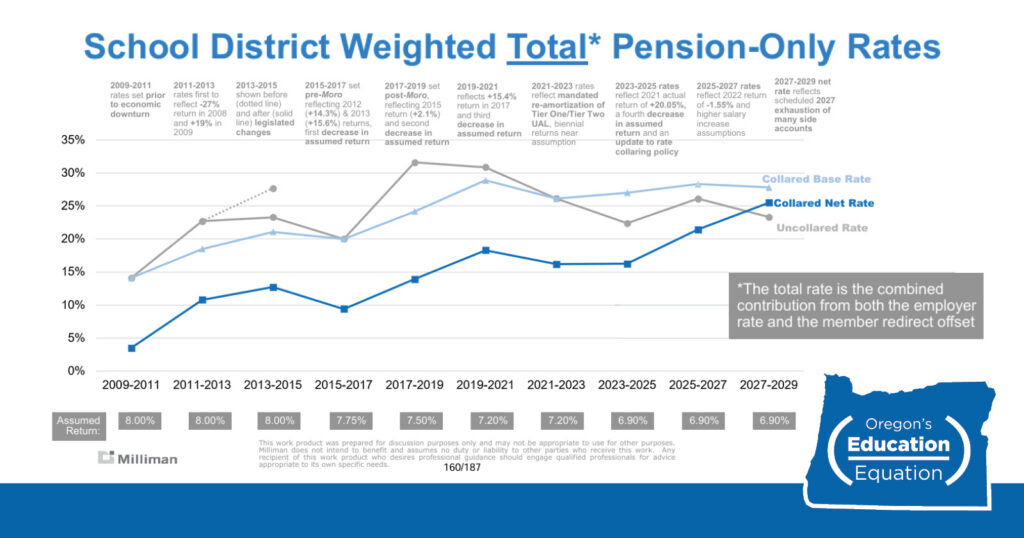
The PERS Board has set an assumed earnings return rate of 6.9%. That means it assumes its investments will earn 6.9% a year and that will be enough along with employer contributions to pay all the benefits.
It used to be higher, but the investments weren’t keeping up. When the PERS Board lowered the rate (which school districts had no say in), contributions had to go up to balance the equation.
If the investments don’t earn enough or more benefits are due than estimated, the contributions fall short, creating unfunded actuarial liability.
The UAL is the difference between what PERS owes all current and future retirees and how much money it actually has. As of the last valuation, the UAL was $22.8 billion, including side accounts.
PERS funded status including side accounts was over 100% before it dropped to 80% in the market crash of 2008. It dropped again when the 2015 Moro v. State of Oregon decision said the Legislature couldn’t reduce already promised benefits.
PERS’ base rate for employers includes a calculation of how much the employer must pay to wipe out its UAL over time.
Employers’ PERS rates started climbing rapidly to make up the debt, but they couldn’t climb too fast because of a “rate collar.” PERS “rate collar” is designed to keep the base PERS rates from changing too much in any one biennium, usually not more than 3 percentage points. The collar keeps the base rates from falling until PERS is 87% funded excluding side accounts. As of Dec. 31, 2025, PERS was 76% funded.
Employers receive two PERS rates: one for Tier 1 and 2 and another for the Oregon Public Service Retirement Plan
Tier 1 applies to people hired before 1996, and Tier 2 applies to people hired between Jan. 1, 1996, and Aug. 28, 2003. They have the best PERS, with some being paid more in retirement than their final paycheck. People hired after Aug. 28, 2003, are enrolled in the Oregon Public Service Retirement Plan, which aims to pay 45% of salary after 30 years of service.
The base rate for 2027-29 will be 27.56% for Tier 1 and 2 and 24.97% for OPSRP.
A district’s PERS rate — a percentage of payroll paid to PERS — depends on the benefit level of current and former staff minus any offsets. A district’s PERS cost — the actual dollar amount a district pays to PERS — also depends on how many staff it has at different benefit levels, what they are being paid and how long they’ve been in PERS. Districts with the same rate would face different costs because of staff demographics.
A side account changes the base rate and throws away the collar. Roughly two-thirds of school entities have side accounts that create their own special rates.
Since 2002, school districts have made side investments in PERS to lower their liability. Basically, they give PERS a chunk of money to invest on the side, and those investments help pay off their PERS costs. Individual districts’ PERS exposure varied widely, and some managed to lower their PERS rate all the way to zero.
Typically, districts have funded these side investments by borrowing money through a bond. It’s a gamble. If they time the interest rates and the market right (and most have), they make more money on their investments than they spend repaying the loan. Their net PERS cost goes down, but it’s not zero even if their PERS rate falls to zero because they still have to pay on the loan.
That loan payment, though, is not reflected in the current service level calculations, meaning the State School Fund formula always underestimates the actual PERS cost to school districts.
The State School Fund’s formula for current service level looks at how much the net PERS rate changes and funds accordingly. The net rate is projected to rise an average of 4.16 percentage points, but districts had to make loan payments to keep that number from being higher.
School districts paid more than $321 million on PERS loan debt in 2025 that is ignored by the current service level calculation, according to the research group Equable.
The Yamhill Carlton Experience
The Yamhill Carlton School District’s gamble on a side account paid off with a PERS rate of zero for years, but now it’s looking at an 8 percentage point increase in its net PERS costs.
Melanie Neece, the Yamhill Carlton fiscal services director, said the district budgets about 25% of its payroll to pay PERS costs. About 19 percentage points of that is payments on its PERS bond, or about $1.3 million a year out of a general fund budget of roughly $18 million.
The district also pays what is known as the 6% “pick up.” Employees are obligated to put 6% of their pay into PERS, but many public employers negotiate to pay that as part of contract benefits. That cost is not reflected in CSL estimates of PERS costs.
Yamhill Carlton’s side account is estimated to expire in 2027, but it could have payments on its loan through 2028 depending on interest rates. Its Tier 1 and 2 rate will jump from zero to 27.56%, and its OPSRP rate will go from zero to 24.97%.
In practical terms, that’s about an 8 percentage point increase in the district’s PERS costs, as it shifts from paying on the loan to paying the PERS base rate, far more than the net rate increase the State School Fund CSL is likely calculating for.
Yamhill Carlton’s net cost for PERS will increase an estimated $785,000 next year, Neece said.
“We’re going to have to look at programs, staffing levels, services and other expenditures that will allow us to absorb that expense,” she said.
The district has already started leaving some positions open to make room in the budget. With roughly 85% of the district’s costs going to payroll, though, there are not many other places to cut than staff or time.
“That’s how we get into trouble with deferred maintenance and things like that,” Neece said.
Into the Future
Expiring side accounts are one of the most pressing budget problems facing some school districts. More than a third of Oregon’s school districts have side accounts that have recently run dry or are near expiring, and the interest rate environment right now is not conducive to re-investing borrowed funds. As those accounts wind down, the districts’ PERS rates leaped this biennium and next because the rate collar doesn’t apply to side account fluctuations.
The high PERS cost also skews public understanding of just how much Oregon is spending on students. More than half of states contribute to their schools’ pension obligations, but PERS is paid by Oregon districts through their State School Fund allocation. That means Oregon is counting pension money in its per-student calculations that many other states do not.
Unless the state can make a major payment to bring down the debt (unlikely in the current budget environment), big PERS costs are a fact of life for the near future until those Tier 1 and 2 obligations move off the books.
Education advocates are wary of any efforts to tweak PERS, though, or to add benefits that might increase PERS debt, because that would start pushing rates up again.
“This is a huge expense and then we couple this with our health insurance and our requirement for leave and our Paid Leave Oregon,” said Neece. “It’s just a lot for the districts to absorb.”
She added that if the Legislature “is going to continue this type of stuff, the funding has to be there to help offset it so we can take care of our staff and our facilities.”
– Jake Arnold, OSBA
[email protected]