Good education news is relative.
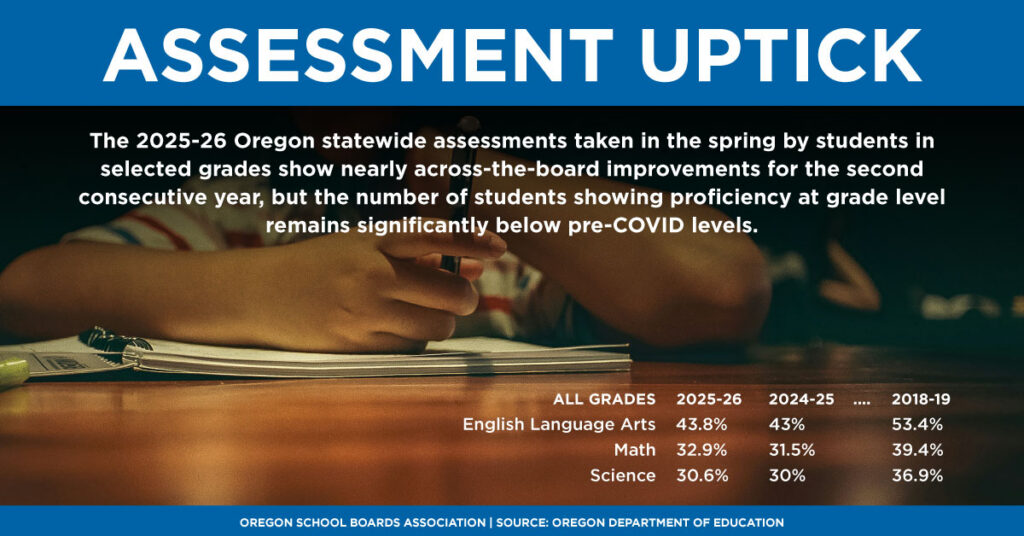
Statewide assessment data published Thursday, Sept. 24, showed nearly across-the-board proficiency improvements in all subjects and grade levels and with most demographic groups. But the gains were small compared with the gap Oregon still needs to make up from pre-COVID scores.
Oregon also raised its percentage of students taking the tests but remained below the federal target for participation. Many education leaders say opt-out policies mean Oregon doesn’t reliably know how its students are performing.
Oregon Department of Education Director Charlene Williams told media on Tuesday that the data showed policies to lift students were working but more sustained effort was needed to make bigger gains.
“Meaningful change doesn’t happen overnight. … We must keep our foot on the gas,” she said.
Every spring, students in grades 3-8 and 11 take standardized summative tests in English language arts and math and students in grades 5, 8 and 11 also take science tests. The tests are aimed at checking the system’s health, not individual student achievement.
Students can receive a score of 1, 2, 3 or 4. A grade of 3 or 4 shows a student consistently performs at or above grade level standards and counts as “proficient.” A score of 1 or 2 shows a student may have some foundational knowledge but isn’t able to consistently perform at grade level.
In English language arts, the percentage of proficient students increased in all grades except eighth. Student proficiency increased the most in fourth grade (1.4 percentage points) and 11th grade (1.6 percentage points).
In math, proficiency improved in all grades with the biggest growth also in fourth (2 percentage points) and 11th (2.6 percentage points).
For both tests, student achievement improved in nearly every student demographic, and it was the second consecutive year of growth for most.
In science, proficiency improved in all three grades, with gains spread across demographic groups.
ODE reported that 97 districts improved in English language arts and 102 improved in math.
The Grants Pass School District did both. It improved 4.4 percentage points in English language arts to 50.9% and 4.2 points in math to 36.1%, with double-digit gains in third and seventh grades.
“We can’t wait to shout it from the rooftops” said Dustin Smith, Grants Pass School Board chair. “It’s the culmination of a lot of hard work from a lot of wonderful educators and also our community.”
The district, with engagement from the community and the school board, created a plan to singularly focus on the teaching of reading and math, said Superintendent Tim Sweeney.
“The kind of jumps we have seen in reading and math in the last year is a vindication of a path we have been on for five years,” Sweeney said.
The district invested in new curriculum and increased its use of interim assessments. Sticking to the plan was crucial, he said.
“The Legislature does these investments and they want results now and that’s not how it works,” Sweeny said. “You need to have the ability and the time to move a district, and that only happens through consistency.”
Sweeney said the district’s improvement took hard work from a lot of people, and he credited time dedicated to professional development.
Susan Zottola, Grants Pass director of elementary education, said that if she could invest in just one thing, she would focus on intentional and high-quality staff training.
She said training was essential to making the most of curriculum and aligning teachers’ efforts.
“We are not in this for short gain,” she said. “We want change that is lasting and is systematic, so it outlives us or any single teacher.”
Smith said that the board set rigorous goals and that the training coupled with data assessment was key to moving toward them.
“When you find something that works, you have to find a way to standardize it and replicate it around the work,” he said. “The only way to do that is to share what the success looks like.”
Sweeney said student participation in the assessment tests was telling as well. Grants Pass has encouraged students to take the tests so it has a more accurate measure of their progress, with total participation rates for all subjects above 95%. That has not been the case for much of the state.
Oregon’s overall participation rates were less than a half-percentage point higher for all three subjects: English language arts at 89.5%, math at 88.5% and science at 86.5%
The federal Every Student Succeeds Act requires 95% of students to take summative tests. Oregon seeks at least 80% participation because less than that does not provide good data, according to Andrea Lockard, ODE Office of Research, Assessment, Data, Accountability, and Reporting assistant superintendent.
Oregon statute, though, requires school districts to notify families that students may opt out. Education leaders say Oregon’s culture of opting out lowers test scores because students and families don’t take them seriously and often the highest performers don’t see a need to take them at all.
Krista Parent, Coalition of Oregon School Administrators executive director, said Oregon needs to revisit its opt-out policy.
“Our new accountability system depends on accurate, complete data, which makes it more important than ever that students are tested at the appropriate grade level and in each designated content area,” she said. “Without that information, we won’t know whether we’re meeting our goals for Oregon’s students.”
Student achievement will be a loaded topic when the Legislature convenes in January, and professional development time is being discussed in the State Board of Education.
OSBA Executive Director Emielle Nischik said an honest discussion of student achievement requires reliable data and Oregon’s opt-out rules are preventing that. The state is sending one message to students, families and educators, that the test is not important, while at the same time doubling down on holding the district accountable, creating an incoherent system, she said.
“This assessment data shows real and sustained progress, but it’s nowhere near where we want it to be,” she said. “We need well-trained educators and we need accurate data to do better.
“Let’s add tools, not take them away.”
– Jake Arnold, OSBA
[email protected]