
U.S. healthcare costs are rising rapidly from a combination of increasing prices, higher public demand and new treatments that cost more.
Health insurance prices have soared to keep pace. When medical care costs more, insurance companies must take in more money from everyone to cover the claims.
School districts around the country are struggling to keep up, and their increased spending on employee health insurance is crowding out other education spending.
Nearly 10 years ago, the Oregon Legislature put a cap on schools’ insurance cost increases to try to hold them down, like a lid on a boiling pot. For years, those rising costs have simply shot out the sides, burning school district budgets and employee paychecks. Health insurance coverage is suffering, the State School Fund process misses the true cost of benefits and now the pressure is so great the cap is threatening to blow right off.
School finances are a volatile mixture of revenue and expenses that often interact in unpredictable ways. Oregon’s Education Equation, an ongoing series from OREdNews, is looking at the forces that shape school budgets. Health insurance costs are one of the biggest factors, and the system is nearing a crisis point.
Data from the past two years indicate around 10% of school district expenditures go to insurance coverage, according to Jackie Olsen, the Oregon Association of School Business Officials executive director.
It wasn’t always so.
Sherry Ely, who is in her 35th year as an Oregon school district finance officer, said that when she started, insurance rates were not a significant cost for school districts.
This year, the Ashland School District where Ely is the interim business services director will spend roughly $4 million on employee health insurance out of an approximately $40 million general budget and count itself lucky.
Ashland joined the Oregon Educators Benefit Board this year, saving a bit over $1 million on its insurance costs from the previous year, according to Ely.
The Legislature created OEBB in 2007 as a response to rapidly rising health insurance costs. OEBB pools together employees from school districts, education service districts, charter schools and community colleges as well as some local governments that opt in. Once an entity joins OEBB, it generally is not allowed to leave.
Ashland had been self-insured, but the rising cost of healthcare made it too expensive and too risky for Ashland to continue that. Insurance companies wouldn’t even give Ashland a quote because its pool of workers is too small, Ely said.
OEBB exists to create a larger pool. Nearly all Oregon’s school districts, education service districts and community colleges buy their health insurance through OEBB. It counts roughly 150,000 people, about half of them the children and spouses of covered employees.
The idea is that the larger the pool, the more attractive it is to insurance companies, increasing OEBB’s bargaining power. A big pool means lots of healthy people pay a little more in premiums than their actual annual healthcare costs, helping cover the expenses of people whose healthcare costs exceed their premiums.
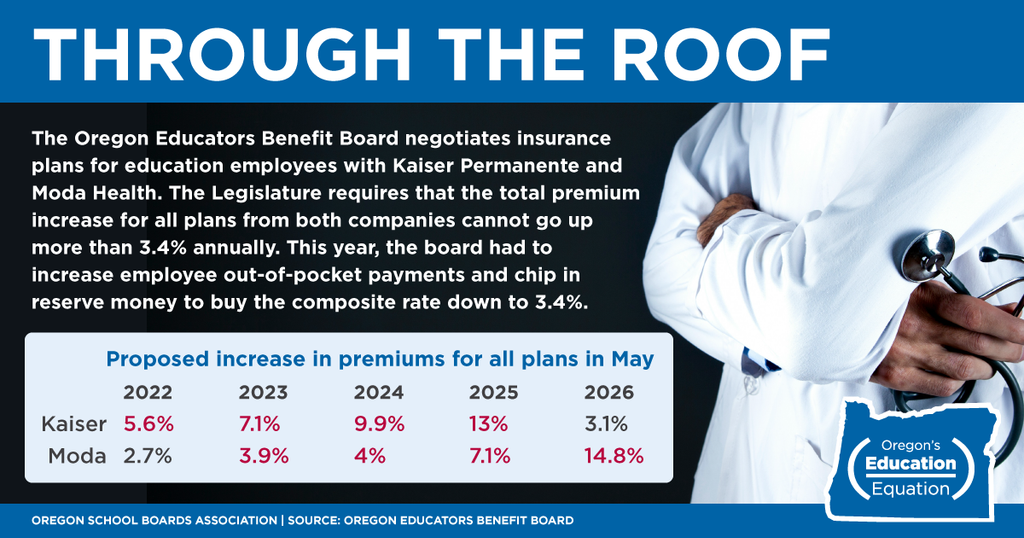
The pool didn’t stop schools’ costs from going up, though. So in 2017, the Legislature mandated that premiums could not increase more than 3.4% annually.
National healthcare costs are still going up. Most recently, healthcare spending rose 7.4% in 2023 and 7.2% in 2024, according to the American Medical Association. Health insurance prices, therefore, have also had to climb.
Nationally, employers are facing the biggest health benefit price increases in a decade, according to OEBB’s 2026-27 renewal summary. The initial estimate this year from the insurers working with OEBB totaled a 13.5% increase for all plans combined.
“3.4% is no longer even close to covering the increasing costs,” said Bill Graupp, an OEBB director and former school board member.
OEBB’s brute pool numbers aren’t enough to force insurance companies to take a loss on their coverage, so OEBB has negotiated where it can. If premiums can’t go up more than 3.4%, the flex points become what the insurance covers, when it kicks in and how much it pays.
Raising the deductible and out-of-pocket maximum, reducing the list of services and medicines covered, and paying a lower percentage of healthcare costs are all “cost mitigation levers” OEBB considers.
The more the policy shifts the expenses to the policyholder, the less it costs.
“The bottom line is we have to take money out of employees’ pockets,” Graupp said.
The Legislature has sometimes complicated the process by adding insurance requirements for procedures or medicines, raising costs and further limiting OEBB’s negotiations.
With so many variables possible in coverage, insurers offer a range of plans that cater to different needs, whether it’s a young and healthy single person or a family with a member with health challenges.
OEBB negotiates for a range of policies that vary in cost, coverage and deductible. Each year, these different plans can have a range of premium increases, because the statute only requires that the composite increase of all the plans together is capped at 3.4%.
OEBB then offers the plans to the districts. In 2026-27, OEBB offered four Kaiser Permanente plans and seven Moda Health plans. They are the only two carriers working with OEBB for health insurance, and Kaiser doesn’t offer service to the whole state. OEBB also works with Willamette Dental and VSP Vision Care.
Districts, often collaborating with their unions as part of contract agreements, decide which plans to offer their employees. Contracts also determine how much of the premium and the deductible a school district will cover and how much the employee pays.
Often districts might choose to offer only one or a couple of plans, particularly smaller districts that have fewer staff to track all the plans and payroll deductions. That means, depending on the plans a district chooses and how much it pays of employees’ premiums, the district’s actual costs can go up more than 3.4%. In 2025, more than half of employer groups offered plans with an increase slightly more than the 3.4% cap, according to OEBB.
Districts’ actual increases matter because of the way the State School Fund current service level formula works. The Legislature’s biennial debate on how much money to allocate to K-12 education starts with an estimate of what it would cost for schools to continue their current staffing and programs with inflation.
The formula assumes healthcare insurance costs will go up by 3.4% because that’s the cap. The reality is far more nuanced.
As less comprehensive and more expensive insurance policies take money out of employees’ pockets, employees are asking school districts to put some of that money back in, pushing schools’ “health insurance” costs into other budget line items.
Health insurance benefits are a key part of contract negotiations. When insurance costs go up, employees request that their employers pay more of the premium or contribute money toward paying deductibles. An employer may also agree to increase employees’ pay or offer other benefits to make up for reduced or more expensive insurance coverage.
Insurance benefits are primary recruitment and retention tools, making staffing more challenging if benefits worsen.
Health insurance is especially important in rural areas where a high percentage of local workers are contractors, farmers, ranchers, self-employed or otherwise without health insurance. Often a family member will choose to work for a public employer more because of the family health insurance than because of the pay.
If the health insurance isn’t worth the work, school districts expect to have more trouble filling some positions, especially crucial part-time positions such as bus driver.
Districts’ true insurance benefit costs end up being more than what they pay to OEBB. If the State School Fund allotment, bound by the cap, doesn’t go up as much as the true cost, then districts have to sacrifice other parts of their education budget to pay for health insurance.
Meanwhile, holding that 3.4% line has become a near impossibility for OEBB. In May, OEBB faced a $91 million gap between the statutory increase maximum and insurance companies’ estimated premiums. Kaiser, which had increases greater than 3.4% the previous four years, was essentially flat, but Moda was seeking a 14.8% premium increase. To bring that premium cost down to the cap would have required increasing both premiums and out-of-pocket maximums by more than $1,000 per person.
The board settled on a plan that relied on increasing deductibles and out-of-pocket maximums by $250 per person to close $11.5 million of the gap. It reduced the gap $15 million further through new efficiencies, but OEBB still had to chip in $64 million, about two-thirds of its reserve funds, to bring the composite plan increase down to 3.4%.
That was just a Band-Aid. The payoff didn’t change the cost of health insurance; it just lowered the premiums for one year.
Insurance premiums still went up nationally this year. Next year, insurance premiums likely will go up again. OEBB will have to account for the jump in prices papered over by the reserve this year in addition to whatever prices go up next year.
OEBB is looking at an estimated increase next plan year of 17.4%. OEBB’s reserves are nearly depleted, making another massive buy-down impossible.
A coalition of education advocates, including OSBA, have encouraged OEBB to go to the 2027 Legislature to look for relief and potentially change the 3.4% cap.
Stacy Michaelson, OSBA’s Government Relations and Communications director, said the cap is no longer actually keeping costs down, it’s just limiting the coverage that districts can offer to their employees.
“The healthcare landscape has changed,” Michaelson said. “The cap is just hiding the real cost of health insurance from the State School Fund, and our employees suffer because of it.”
– Jake Arnold, OSBA
[email protected]


