
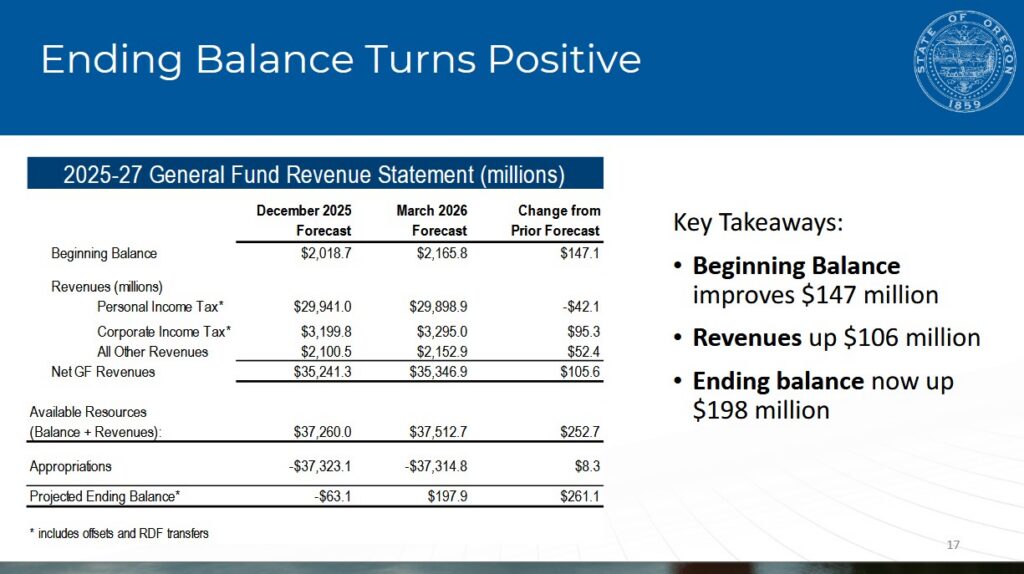
Going into the legislative session Monday, state agencies and school districts were bracing for funding cuts to make up a projected budget shortfall. The Oregon Economic and Revenue Forecast released Wednesday says the Oregon General Fund is technically back in the black, with a projected $198 million positive ending balance for this biennium.
“We have seen an impressive resilience in the economy over the last couple of quarters,” Oregon Chief Economist Carl Riccadonna told a joint hearing of the House and Senate revenue committees.
But the federal HR 1, known as the “One Big Beautiful Bill,” simultaneously reduced Oregon’s revenue and increased the state’s expenses. The Legislature is still looking at a gap of hundreds of millions to make the budget whole and keep some money in reserve.
Riccadonna said the quarterly economic report has some concerning and conflicting numbers but Oregon’s economy has performed roughly as expected with some additional stimulus from federal policy.
Oregon’s budget picture is a far cry from August when a recently passed federal tax and spending bill knocked the bottom out of Oregon’s budget, setting up a total budget hole close to $900 million. With significant new costs added by the federal government since the budget was adopted last June, the state will need to find additional savings or funds. Exactly how much is still to be determined.
The Oregon economy is chugging along at roughly the same pace as in November but the risk of a recession in the next 12 months has dropped to around 20%, state economists said.
Oregon revenue projections increased $106 million from the last quarter, mostly from corporate taxes, but state economists also said it’s too early in the tax season to be fully confident about projected collections. The corporate activities tax, which pays for the Student Success funds, ticked up a negligible $18 million from the last forecast to $3 billion.
Much of the state’s improved financial condition came from a larger than expected carry-over from the previous biennium of unspent funds. The financial year ended June 30, but state agencies have an additional six months to spend their funds from 2023-25. When the receipts were totaled up after Dec. 31, Oregon had $147 million more than predicted.
All told, the Legislature has roughly $300 million more than it did in December.
It’s not a recipe for expanded investments, but it gives the Legislature a bit more breathing room as it navigates the impacts of HR 1. Some of those are fixed costs, as the state has to pick up a greater percentage of the administrative costs and actual benefit payments of programs such as the Supplemental Nutrition Assistance Program. Some costs are less straightforward as the Oregon Health Authority and Oregon Department of Human Services require additional staff to meet new federal requirements around eligibility determinations.
The Legislature also likes to keep several hundred million on hand for unexpected expenses, such as 2025’s elevated wildfire fighting costs. Overall, the Oregon revenue outlook is still down from the close of session forecast before HR 1’s impacts, when the Oregon budget built in a $473 million ending balance.
The size of any hole could also be influenced by any changes the Legislature makes on the revenue side of the ledger, such as whether Oregon continues to include the same tax breaks included in HR 1 at the state level or not.
Sen. Anthony Broadman, Senate Revenue and Finance Committee chair, opened the meeting immediately following the report by saying the Oregon economy still faced “headwinds.”
Education advocates are highlighting the need for stability in education funding. To properly plan and sustain programs and retain educators, school leaders need to know they can count on maintaining their budgets, said OSBA Executive Director Emielle Nischik.
“The recent record graduation report showed Oregon schools are making progress, and we need to talk about what it will take to keep that success going,” Nischik said. “The Legislature has important choices to make this session that will shape school districts’ ability to provide for their students into the future.”
– Jake Arnold, OSBA
[email protected]