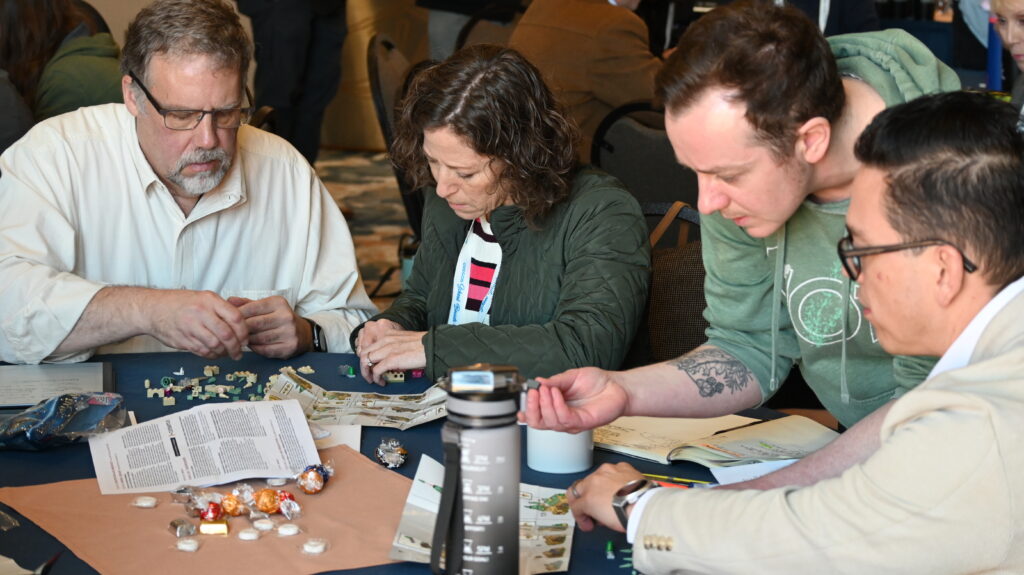
Small groups work together to build a Lego version of Hogwarts School in a workshop at the Bonds, Ballots and Buildings conference Friday, Feb. 6, in Salem. (Photo by Lionel Lynner)
After losing a $172.5 million bond attempt last November, the Oregon Trail School District is considering another try, according to Garth Guibord, the district’s communications director.
“Buildings don’t stop aging just because bonds fail,” he said.
Guibord found lots of inspiration for rebounding after a loss at OSBA’s Bonds, Ballots and Buildings conference on Friday, Feb. 6, at the Salem Convention Center. The conference, which will become an annual event starting next year, offers training, resources and a chance for school leaders to mix with industry professionals and experts. It’s also a chance to learn from peers.
Molalla River School District Superintendent Tony Mann outlined how his district finally found success in May 2024 after five failed bond attempts. Morrow County Superintendent Matt Combe told how his district bounced back from a bond defeat in 2022 to pass a $270.5 million bond three years later. Sheridan Superintendent Dorie Vickery detailed ways her district found success in 2025 after two prior bond losses.
All three districts shared strategies for community engagement and stressed the importance of face-to-face contact with voters.
“We did a full court press on this,” said Combe, telling how they made bond presentations to every community group that would have them.
The conference drew about 220 school district leaders and experts in finance, construction, education and communications. Sessions ranged from the basics of planning a bond project to best-practice strategies around polling, community engagement and construction management.
For many, a highlight was hearing from others who have successfully passed money measures.
“Listening to other people’s stories, I got a lot of good ideas,” said Mike Wagner, a North Santiam School District board member. “I’m very pleased with what I learned today.”
OSBA Executive Director Emielle Nischik said the conference, traditionally held every other year, will move to an annual event to better help districts as they pursue bonds and levies. Next year’s conference will be March 12 at the Salem Convention Center.
She noted that the need for bond measures is ongoing as schools deal with the reality of aging buildings and facilities that don’t meet modern learning needs for technology, space, design, health and safety. The National Council on School Facilities estimated that as of 2025, it would require $90 billion to bring U.S. public K-12 facilities up to standards.
A common theme of the conference was the importance of knowing your community. Tillamook Interim Superintendent Jennifer Guarcello told how her district’s successful bond included construction of two new gymnasiums. That’s contrary to the advice of many experts who caution against including major athletic projects because voters often view them as frills, not educational necessities. That’s not the case in Tillamook, said Guarcello.
“Athletics are key in our community,” she said.
Majalise Tolan, superintendent of the Lincoln County School District, emphasized the importance of consistent messaging that centers on what’s best for students. She feels that was a factor in her district’s successful bond renewal measure in May 2025.
“All children need to be safe,” she said. “They need a warm and dry place to go to school.”
Jeremy Wright, owner of Wright Public Affairs, said bond projects, much like big aircraft, need a long runway to assure success. He suggested a timeline of at least 18 months to do the facility planning, polling and community engagement needed to shape a successful bond measure. Of the campaigns his company has worked on since 2015, he said 90% of those who started at least a year before the election were successful.
“The pattern is clear,” he said. “Winners give themselves enough runway.”
Scott Rose, senior project manager for R&C Management, told one workshop that authenticity and transparency are crucial to building voter trust. He said it’s important to use actual figures showing the cost of bond components.
“Data is huge,” he said. “They need to see the sausage being made.”
For Charlotte Hutt, a board member from the South Coast Education Service District, the conference offered a chance “to get my feet in the water” and learn what all is involved in a bond campaign. Her district is considering seeking a bond measure that could provide help with career and technical education for the 10 school districts it serves.
“I’ve gotten some good ideas,” she said.
Rose, the senior project manager, offered some parting advice for districts: Whether you just passed a bond or are preparing for a new one, your work is not done.
“The moment you pass your bond,” he said, “you are marketing for your next one.”
– Connie Potter