
The fourth-quarter revenue report, the last stop before Oregon starts throwing around State School Fund numbers, held no surprises.
Senior Economist Michael Kennedy said projections for major 2025-27 revenue streams changed less than 1 percentage point from the previous quarterly forecast.
The revenue forecast for 2025-27 increased $11 million from the previous quarter, a statistically insignificant number. The forecast for 2027-29, which helps determine the State School Fund, showed a $245 million increase in available revenues.
The Oregon Economic and Revenue Forecast presented to the Legislature on Wednesday, Nov. 18, offers the final revenue numbers for the governor’s recommended budget.
In the next two weeks, Gov. Tina Kotek is expected to release a rough draft of what she thinks the Oregon budget should be. It’s not legally binding, but it’s a good indication of the direction the Legislature will go, especially considering her party, the Democrats, are firmly in control.
The Legislature typically will set much of the state budget based on the next forecast in February and then adjust its numbers based on the May forecast.
After years of wild swings that led to huge kicker tax refunds, the Office of Economic Analysis adjusted its model in 2024. Recent forecasts have consistently hit closer to the mark. The current forecast predicts no personal kicker and a $71 million corporate kicker, which is dedicated to K-12 education. The kicker only comes into play if revenue exceeds the close-of-session budget by more than 2%.
The forecast for the 2025-27 biennium projects a $411 million ending balance, near the $472 million ending balance projected when the Legislature wrote the budget in 2025.
Wednesday’s forecast predicted a 19% increase in net general fund revenue for 2025-27. Early estimates for maintaining a current service level in schools would require a State School Fund of at least $12.6 billion, a 10.5% increase.
But under HR 1 (2025), the “One Big Beautiful Bill,” states are getting less support from the federal government, and Oregon’s budget will need to fill some of those holes. Oregon predicts needing to fill roughly a $420 million loss in Medicaid funding alone.
For school leaders, the collections for the corporate activity tax that supports the Student Success Act are of particular interest. Wednesday’s forecast was essentially flat, with a $15 million increase for 2025-27 and a $9 million increase for 2027-29 from the previous forecast. The tax is expected to collect $3.4 billion for 2027-29, a 15% increase from the previous biennium.
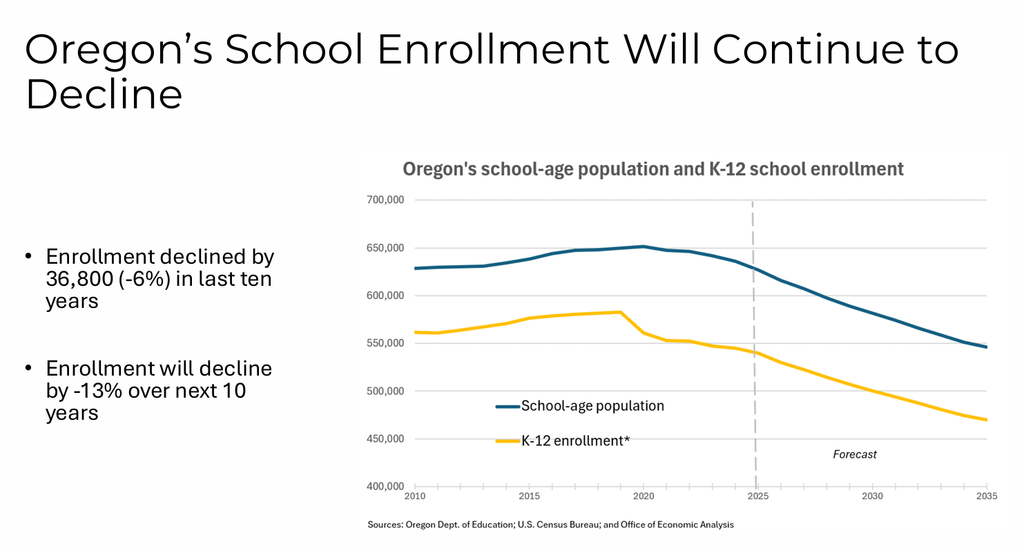
The economic forecast includes a wide range of demographic data, as changes in the population affect the economy. The forecast noted that K-12 enrollment has declined 6% in the past 10 years and is expected to decrease 13% over the next 10 years.
There remains about an 18% chance of a recession, according to Carl Riccadonna, Oregon’s chief economist. The average economic expansion lasts about six years, Riccadonna told a joint hearing of the House and Senate revenue committees Wednesday. Oregon is in year six of the latest expansion, but its economic fundamentals are more similar to mid-cycle on an expansion, Riccadonna said.
Oregon, however, has healthy reserves for a downturn. The Education Stability Fund holds $1.2 billion, and the Rainy Day Fund holds $2 billion, with both amounts projected to increase this biennium to a combined total of $3.5 billion. That’s almost 10% of the General Fund forecast.
– Jake Arnold, OSBA
[email protected]


