The Oregon State Board of Education adopted rules Thursday for the state’s new “performance growth targets” while expressing skepticism about the support to help schools achieve those targets.
The Oregon Department of Education’s answers mostly boiled down to: We’re working on it.
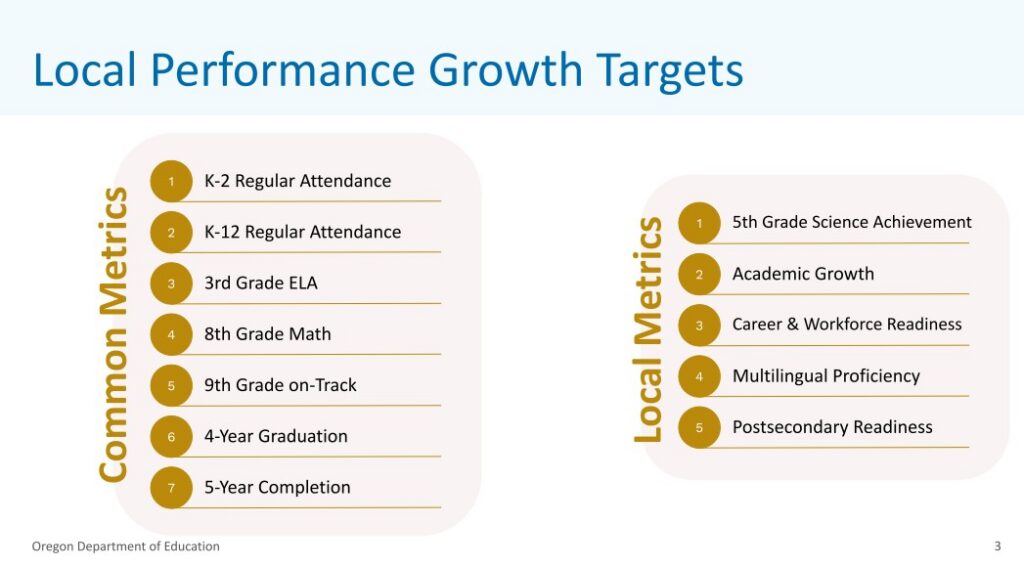
The 2025 Education Accountability Act requires school districts to meet eight performance metrics: seven statewide targets and one local target chosen by the district from a list of five. If they don’t, ODE can step in with coaching and eventually partial control of district funds.
ODE has been meeting with education partners, including OSBA, for much of the past year to work out the details.
Last month, the board adopted the statewide targets. By this fall, each district is expected to set local targets that align with the overarching statewide goals. In Thursday’s meeting, the board adopted rules for what it means for a district to meet its targets and what happens if a district doesn’t.
School districts will have baseline targets for all students and “gap-closing targets” aimed at getting all student to the same level of proficiency. For every metric, districts must either meet the baseline and gap-closing targets or meet one target and satisfy an ODE review that progress is being made to meet the other.
If a district fails to meet a metric for two consecutive years, it must accept “directed” coaching from ODE. If directed coaching doesn’t lift the district’s performance within two years, it moves to “intensive” coaching from ODE, a more systemwide approach that comes with funding to support the work.
Similarly, if a district fails to meet targets in any two or more metrics for three consecutive years, it moves into intensive coaching.
Once in, a district must participate in intensive coaching for a minimum of two years.
If a district fails to meet targets for four years, ODE can take control of up to 25% of a district’s State School Fund and Student Investment Account money. ODE must contract with a school budgeting expert for that work.
ODE is offering professional development, technical assistance and optional customized coaching now to help districts meet their targets. The directed coaching will start with the 2028-29 school year, and intensive coaching will start in 2029-30.
Districts are setting their targets now, and 2026-27 will be the first measured year. Districts will need to publicly share their results, including in a school board meeting.
State Board 2nd Vice Chair Cynthia Richardson said she is hearing that some districts expect to fail because they don’t have the funding and the supports they need to improve. She asked if ODE has the capacity to do the amount of coaching that will likely be needed.
Tim Boyd of the ODE Office of Education Innovation and Improvement said ODE is working to lessen the need for interventions by leaning into coaching, regional supports and partnerships with education service districts to provide help.
Cassie Medina, the office’s assistant superintendent, said ODE is still working through its implementation details. She said the Legislature will determine how much money ODE will be able to devote to coaching and other supports in the 2027-29 budget.
As the meeting neared the end, the discussion again returned to what school districts will need to meet all these requirements.
“Got to have the money to be able to do it,” Richardson said.
Board Chair Jennifer Scurlock had one final plea before the board unanimously adopted the rules.
“I hope we can have funded mandates, that there is money behind the decisions that are being made,” she said.
– Jake Arnold, OSBA
[email protected]