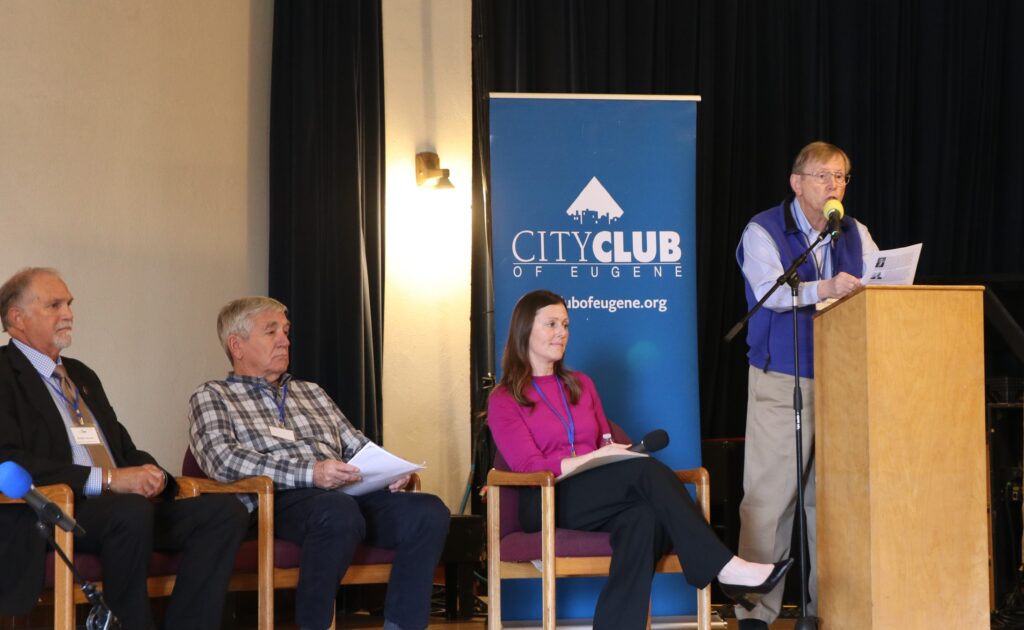
City Club of Eugene Program Director Eric Dziura introduces the panel on Friday, Feb. 27, to talk about “Effective Public Governance Boards”: (from left) Eugene City Councilor Randy Groves, Eugene Water & Electric Board President John Brown and OSBA Executive Director Emielle Nischik. (Photo by Jake Arnold, OSBA)
Every community has a variety of boards, ranging from school boards to county commissioners. Many board members are unpaid volunteers charged with governing public entities, often with little or no experience.
Lane County has “too many examples of not good governance,” according to Eric Dziura, program coordinator for City Club of Eugene.
City Club, which is devoted to public discourse and information, held a forum on “Effective Public Governance Boards” on Friday, Feb. 27, in Eugene’s WOW Hall to try to help raise the level of board work in the area. About four dozen people turned out in person, and the event was expected to reach hundreds more through its recorded livestream and its broadcast Monday, March 2, on KLCC.
The forum featured three speakers talking about how different boards operate: OSBA Executive Director Emielle Nischik, Eugene Water & Electric Board President John Brown and Eugene City Councilor Randy Groves.
Groves and Brown talked about what it’s like to serve on different types of boards, and Nischik dove into the best practices for serving on a board.
Dziura, a former Medford School Board member, said he reached out to OSBA for a panel member because of the association’s particular expertise in board governance.
“OSBA is a great resource for training or getting out of a pickle,” Dziura said.
Nischik was the opening speaker on the three-person panel, sharing the Balanced Governance practices that OSBA uses to train school boards around the state. She let the audience know she was condensing a three-hour training into a 15-minute talk, but she quickly got to the heart of an understanding that is important to all boards.
“The first thing that a public board, and also the public honestly, really needs to understand is that governance is not management,” she said.
According to Nischik, governance is about strategic planning and setting policies, not the day-to-day details. Governance is about the what, not the how, she said.
The presentations were followed by about 20 minutes of questions and answers.
Dziura said the exchange would help voters evaluate whether their elected officials are operating in the manner they should.
– Jake Arnold, OSBA
[email protected]