OSBA Governance Review
Purpose
The OSBA Board is conducting a comprehensive review to ensure our governance structure truly empowers our mission and elevates the member experience. We will be partnering once again with the Coraggio Group, whose strategic guidance helped shape many of the positive changes of the past two years, to take a fresh, data driven look at our caucus model, committees, and Board structure to determine whether our current complexity strengthens or limits our impact.
According to OSBA policy, the Governance Committee conducts a full governance structure review every three years. As part of this cycle, any updates that call for member involvement will be shared with the full membership for a vote in the fall, supporting transparency, accountability, and a strong sense of collective ownership. Throughout the process, the Committee remains committed to inviting member input and providing regular updates to ensure clarity and openness at every stage. Whether the outcome reaffirms our current structure or inspires thoughtful evolution, this comprehensive review underscores our dedication to meaningful governance, continuous improvement, and a stronger OSBA for the long run.
Guiding Principles

To ensure this review is grounded, consistent, and aligned with our values, the Board will be using the following set of guiding principles to shape the evaluation process. These principles serve as a compass to help assess potential changes with clarity, fairness, and a focus on long‑term organizational health.
- Effectiveness – Ensure governance structures enable the board to fulfill its core responsibilities: strategic oversight, policy governance, fiduciary accountability, and organizational leadership.
- Efficiency – Design structures that make purposeful use of staff resources and board member time. Every committee, caucus, and process should add clear value.
- Engagement – Ensure boards as entities have genuine opportunities to participate and inform decisions without creating administrative burden or unnecessary complexity.
- Representation – Balance representation between boards as fundamental units and districts serving larger student populations, ensuring all member voices carry appropriate weight while maintaining geographic practicality.
Key Milestones and Future Focus
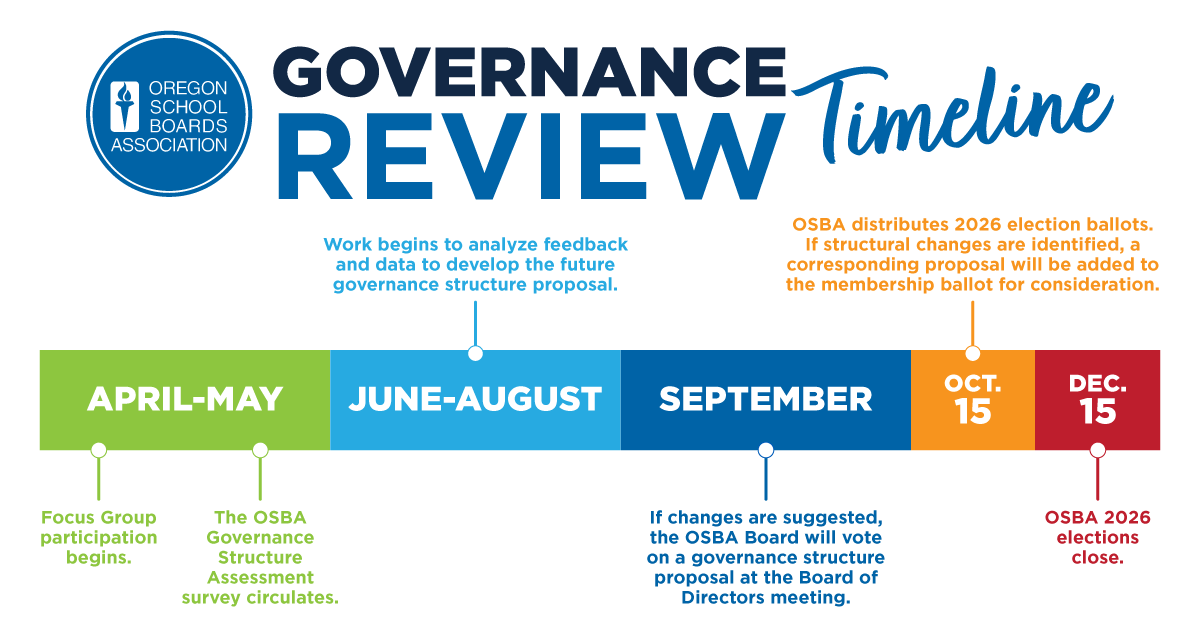
February-March 2026
Staff worked with the Coraggio Group to kickoff the project, collecting and reviewing background data, current state mapping, and best practices.
April-June 2026
The Coraggio Group collected feedback from members, education leaders, and staff through a membership-wide survey with 188 stakeholders returns, 12 one-on-one interviews, seven focus groups, and a scan of school board association bylaws across more than thirty states.
August-September 2026
The Coraggio Group presented the Board Governance Structure Review Report to the Governance Committee. The Committee received the report, considered emerging themes (e.g., Board size, Governance and advocacy confusion, Board’s self-understanding of OSBA’s work, impact of non-voting ex-officio positions, and the effectiveness of both the caucus and the advisory committee model), and developed a multi-layered approach to address each of the identified key findings. The Committee acknowledged that not everything could be resolved by structural changes alone; and that building better communication pathways and updating internal practices would be integral parts of the process.
September 2026
At the Board’s September meeting, it received the Committee’s recommendations for structural changes, which focused on board size, the caucus model, and Legislative Policy Committee service, and took action to adopt the resolution and referred it to the membership for vote during the 2026 election.
December 2026
The membership will or will not vote to adopt the resolution to update the OSBA Bylaws. If the resolution is adopted, then the remaining projected timeline will become effective.
January 2027
Changes to the OSBA Bylaws, other than the Caucus Council revisions, adopted by the OSBA membership, go into effect on January 1.
January-June 2027
Policy Committee develops policies to operationalize the Caucus Council, and the Executive Director develops processes to operationalize the executive director caucuses.
July 2027
Changes to the Caucus model go into effect on July 1.
Each executive director caucus will begin the process for developing individualized operating procedures to guide the work.
The OSBA Board of Directors requests your feedback.

Executive Summary
The Executive Summery provides an overview of the governance changes recommended following the OSBA Board Governance Committee’s 2026 governance assessment.


OSBA History

1849
The territorial legislature of Oregon passed a law establishing the office of school director. Three directors were to be elected annually in each school district.
1946
A small group of school board members meeting in Eugene established OSBA and determined its headquarters would be at the University of Oregon. The association’s initial task was to secure regular and equal financial support for all Oregon schools. Initiating a basic school support law was the first order of priority.
1948
The Attorney General ruled that school districts did not have the authority to pay dues to an association. Some board members joined as individuals and paid dues from their own pockets.
1953
The legislature gave school boards the authority to participate in OSBA and pay dues to an association.
1963
OSBA membership adopted the Oregon School Boards Association Constitution.
1981
The OSBA board changed from a District at Large model to Congressional District model in 1981/1982.
2008
The OSBA board changed to a regional structure with 19 positions spanning 14 regions.
2017
OSBA formally incorporated under ORS Chapter 65 as a nonprofit to ensure OSBA can maintain its political and legislative advocacy program. The original bylaws were adopted by the OSBA Board of Directors on September 15, 2017, and were approved by the membership on December 15, 2017.
2019
The OSBA board added a position to the Clackamas region and a position for the Oregon School Board Members of Color Caucus, totaling 21 positions spanning 14 regions.
2024
The OSBA board added a position for the Oregon Rural School Board Members Caucus, totaling 22 positions spanning 14 regions.