
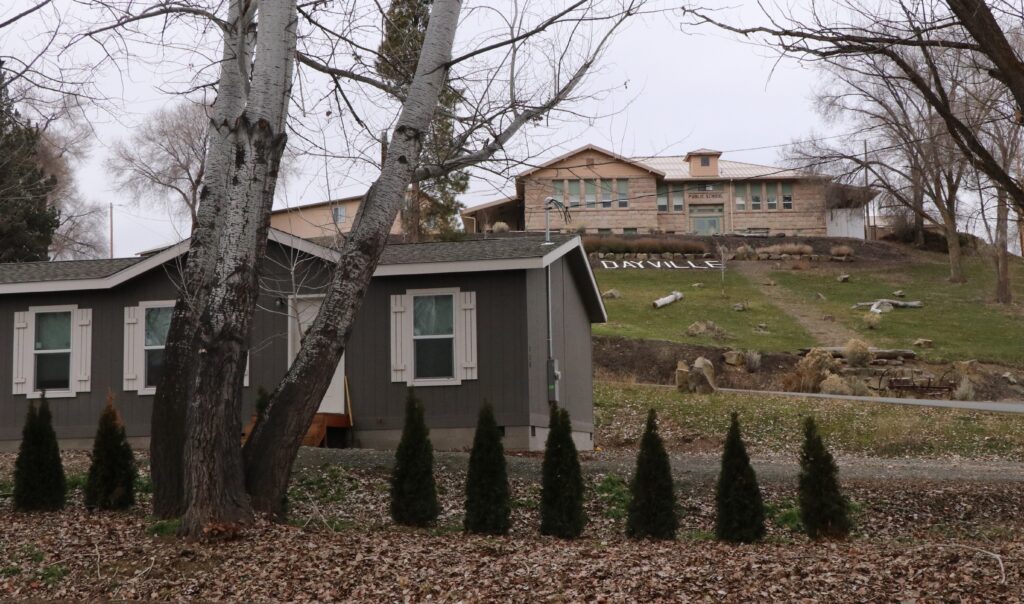
The Dayville School sits on the top of a hill, overlooking the district’s new home for a teacher on the edge of the campus property. (Photo by Jake Arnold, OSBA)
Dayville has roughly 130 residents and almost no long-term housing rentals. Grant County’s largest city of John Day is 30 miles away and offers little more.
Zillow had zero rental listings for all Grant County in the fall. Realtor.com had one apartment in John Day. In the past, that would have been a problem when the Dayville School District was trying to hire a teacher for the new school year. But Dayville built a house specifically to recruit teachers.
“It was a huge incentive,” said Dakota Perkins, Dayville’s new fifth and sixth grade teacher. “When they offered, it was an immediate yes.”
Teacher housing is a national issue, with the cost of homes rising faster than teacher pay, according to the National Council on Teacher Quality. As in other states, scarcity and affordability are twin problems in Oregon.
Appropriate housing can be difficult to afford on an average salary in most parts of Oregon. In smaller and rural communities, the limited available housing often isn’t even suitable for a family while also being expensive or inconveniently far away.
Many rural districts have long had homes for their superintendents, but increasingly, small districts are exploring ways to provide affordable housing to lure and keep teachers and staff.
The Bend-La Pine School District, for example, is working with the Bend-La Pine Habitat for Humanity to create dozens of affordable homes that will give district workers preference for buying.
The Pine Eagle School District near Baker City unsuccessfully sought money from the Legislature in the recent session to build duplexes for teachers. The district will look for grants and other sources of building funds, according to a Baker City Herald story.
Dayville connected with the Eastern Oregon Regional Educator Network to build its house. Oregon regional educator networks were set up to provide additional training and professional support for teachers.
The network provided a $125,000 grant in 2023. The grant paid for a double-wide manufactured home, and the district paid to prepare the site on the edge of school property. The home sits just down the hill from the school, a short but steep walk.

A stone near the Dayville School District’s home for a teacher memorializes the Eastern Oregon Regional Educator Network’s grant to buy the house. (Photo courtesy of Dakota Perkins)
Dayville School Board Chair Casey Fretwell said hiring staff has been a challenge for at least the past decade because of the scarcity and expense of local housing.
“Houses aren’t available, and people are naming their prices,” he said.
The school board deliberated hard about the district cost, he said, but decided their goal was to create a home a teacher could afford with a rent that would cover district costs. Profit was not the goal.
“To actually get a teacher in there, it was an investment we were willing to make,” Fretwell said.
Offering affordable housing is an undeniable recruiting tool but school leaders must tread carefully through the legal questions, according to Haley Percell, OSBA chief legal officer and deputy executive director.
Percell said all arrangements should be documented in writing and districts should consult a landlord-tenant attorney. Districts also must consider what happens when an employee living in district housing leaves employment, she said.
Perkins plans to be with Dayville for a long time, but if she leaves district employment, she will need to move out soon after.
The district also has a manufactured home on campus for the superintendent, but Superintendent Tiffnie Schmadeka, who started as a teacher in the district in 2014, already has a home.
The district used that housing to hire a custodial assistant. The staff member is moving out this month, and the district will look at offering the home to a teacher at a rate similar to the new teacher housing.
Perkins pays $700 a month, considerably less than an apartment in John Day costs.
Schmadeka said the district has lost people because they couldn’t find housing nearby and grew tired of commuting from John Day. The house was one answer to how the district could bring in good quality teachers and keep them, she said.
Dayville employs about 20, including seven teachers. All except Perkins and a science teacher who lives in John Day are longtime area residents.
Schmadeka said keeping staff happy is important because turnover is hard to absorb with only seven teachers. The remaining teachers must take on more students or teach subjects they are not as comfortable with. At the upper grades, it also means more online classes.
“We lose students when we do that,” said Schmadeka. With fewer than 50 students in the district, losing even one or two students has a big impact, she said.
Perkins, who was an instructional assistant in Fossil, wants a long career in Dayville, where she grew up and has family. Fossil is more than an hour’s drive from Dayville when the roads are clear, and she was renting a room from an uncle because she couldn’t afford area housing.
“It’s not the kind of place you want to live as an adult with a job,” she said.
Perkins, a first-year teacher, is working on an emergency license while she tests for her teaching degree. She said Dayville has made her feel supported, in no small part because of the security of having a good place to live.
It can be odd having your superintendent as your property manager and the school board as your landlord. She recently had to go through a three-month process that involved public meetings to add a shed to the property.
Still, Perkins said she actually finds it comforting knowing her boss can look out her office window and keep an eye on her home.
“I can’t say enough about how amazing it’s been,” she said. “This school I work for wants to bring people in and made it possible to move here.”
– Jake Arnold, OSBA
[email protected]