
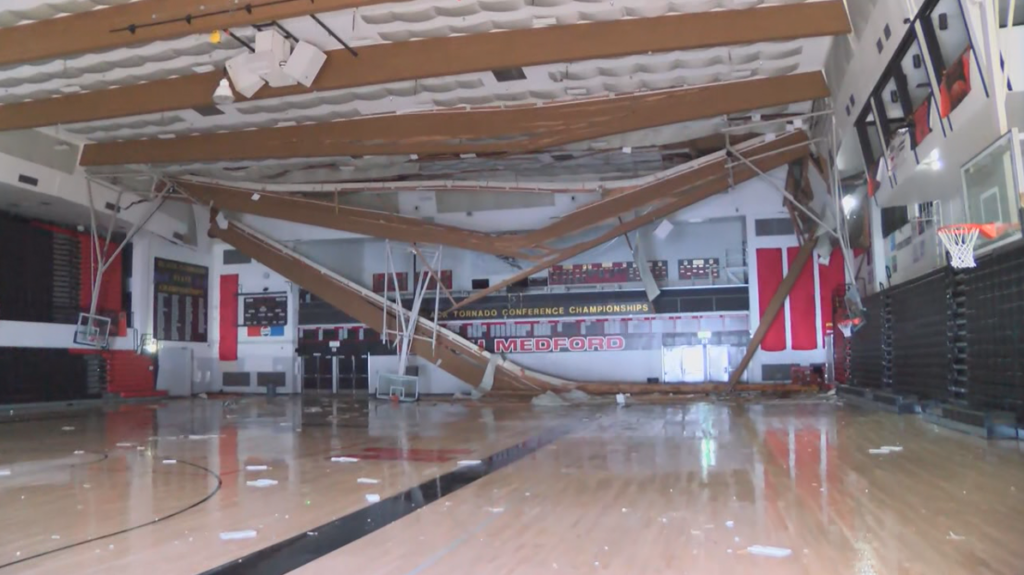
The North Medford High School gymnasium roof collapsed under the weight of snow in February 2025, one of several incidents in recent years that have led to tightened requirements for insuring schools’ engineered wood roof systems. (Photo courtesy of KDRV)
Oregon has several grant programs to help with school facilities work, but first districts must assess their needs to apply for the grants. Assessments require budget money, though, so the Oregon Department of Education has grants specifically for assessments.
The Technical Assistance Program application window is open until Feb. 13 for 2026 grants totaling up to $1.5 million. These grants can help with assessments important for the Oregon School Capital Improvement Matching program, the Seismic Rehabilitation Grant Program and insurance coverage for school districts and education service districts.
This year, the ODE Office of School Facilities added a new assessment grant specifically to address changing school insurance needs related to engineered wood roof systems.
Grant awards will be announced no later than March 13. The four 2026 TAP grants have been adjusted for inflation:
- Long-Range Facility Planning ($40,840)
- Seismic Assessment ($25,525)
- Asbestos Hazard Assessment ($25,525)
- Engineered Wood Roof Systems Assessment ($10,210 for districts with up to four long-span facilities; $25,525 for districts with five or more long-span facilities)
Each grant type requires a separate one-page application. School districts and education service districts can apply for the same grant type only once every four years.
The project period for 2026 TAP grant work is July 1 through Dec. 31, 2027.
Leanna Heiman, ODE’s program administrator for TAP and OSCIM, said the Office of School Facilities is working to be more in line with the state’s accounting practices so schools need to consider reimbursement timelines carefully. She encouraged contractors and school business officials to contact her at [email protected] if they have questions.
Districts must have a long-range plan and a facility assessment to apply for an OSCIM grant. ODE will not be offering a facility assessment grant this year because districts can use their Statewide School Facility Assessment Program reports to meet the OSCIM facility assessment requirement.
Several school roof collapses under snow and ice in recent years have led to increased scrutiny of engineered wood roof systems, especially older ones. Property and Casualty Coverage for Education’s reinsurance carrier required coverage changes for large-span trusses and beams, such as those often seen in gyms, cafeterias and auditoriums.
Nearly all the school districts, education service districts and community colleges in Oregon have insurance through Property and Casualty Coverage for Education. PACE, which is administered by OSBA and the Special Districts Association of Oregon, is an insurance pool, meaning members share the costs and risks.
PACE recently updated its coverage language to specifically exclude coverage for failures of engineered wood trusses that are more than 50 years old if, at the time of an otherwise covered loss, there is evidence of preexisting structural damage that was not properly repaired in accordance with an engineer’s recommendations.
An assessment can provide evidence that the structure was sound before the collapse, but those assessments can get expensive as engineers have to look behind walls and in roofs. That’s where the grants come in handy for districts.
“If you have bowstring trusses over 50 years old, it’s worth it to go after one of these grants,” said Dave Harvey, PACE administration director. “Don’t gamble with your buildings.”
Changes to the coverage this year caused some confusion, including among state agencies, Harvey said. PACE has created a guidance to help explain the conditions, and Harvey encouraged districts to call their agent of record if they have questions.
Harvey said that when districts prevent costly claims through assessments and maintenance, they not only save themselves money but they also help hold down the costs for everyone’s insurance.
“Preventative work helps everybody,” Harvey said, “and that leads to safer buildings for our students.”
– Jake Arnold, OSBA
[email protected]