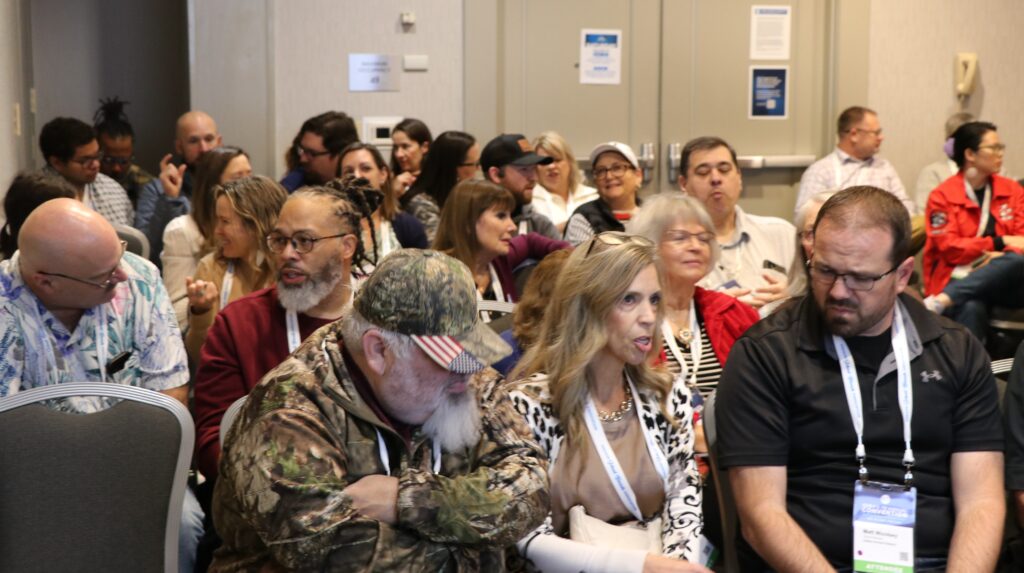
School board members at the OSBA Annual Convention in Portland have lively conversations Saturday during a packed Oregon Department of Education workshop on the emerging school accountability rules from Senate Bill 141. (Photo by Jake Arnold, OSBA)
Four Oregon legislators told OSBA Annual Convention attendees on Saturday morning that Salem needs to hear their district-level perspectives on state policies.
A few minutes later, school board members filled a workshop room to capacity for a session on Senate Bill 141, the recently passed school accountability legislation. Oregon Department of Education staff offered information and heard sharp feedback from school board members.
Proposed metrics to monitor school performance were among the biggest concerns. The metrics had only just been taken before the State Board of Education for feedback on Thursday. The state board is expected to make a rules decision in December.
OSBA conferences have long offered a mix of core information for school board members, training on emerging requirements and inspiring new ideas. With so much turmoil at the state and federal level, though, the 79th OSBA Annual Convention on Friday and Saturday in Portland leaned into the training, with new and evolving workshops to respond to school districts’ immediate needs.
More than 500 registered for OSBA’s two preconferences, a day-long conference for school attorneys and the two-day conference at the Portland Marriott Downtown Waterfront hotel. Workshop sessions tackled ever-shifting topics, including free speech, public meeting laws and government ethics. Workshops also covered complicated issues such as school funding, community engagement and strategic planning.
With a theme of “Building Bridges to Student Success,” the convention emphasized the need for school board members to build relationships with their staff, students, communities, businesses and each other to better serve students.
Lu Ann Anderson, a McMinnville School Board member, gave the government ethics requirements session as an example of the learning she sought, but she also welcomed the chance to make connections.
“I like the sense of collegiality,” she said, “and I like the relevance of the sessions.”
Anderson was among members who praised keynote speaker Matt Lehrman, co-founder of Social Prosperity Partners and a civic facilitator. Lehrman offered timely advice on “Leading Through Complexity,” with practical tools for making thoughtful and forward-looking decisions while under pressure.
Lehrman also spoke at a joint session of OSBA’s Thursday preconferences for school board members and administrative professionals. In a session on “From Conflict to Conversation,” he talked about how leadership grounded in courage, civility and trust can build relationship bridges in tense times.
The OSBA Board Development team has been working on finding more ways to support members, including regional trainers, online training and developing a manual for new board members. The convention included two sessions on an innovative OSBA cohort model for new board members that is designed to support board members through their first two years. The cohort will give additional access to trainings, conferences, mentorships and peer connections.
The convention has also increased training specifically targeted for administrative professionals who serve as board secretaries or executive assistants. Skilled administrative professionals are essential to smooth board governance, and yet the position is often filled with people who have little previous experience. It’s also typically a solo role in the district with no one in a work-alike group to call on.
OSBA gives administrative professionals crucial training and helps them connect with each other for support and learning. OSBA has added a strand of workshops within the full convention for administrative professionals.
The Capitol Watch general session panel was another recent change in the main convention. Four legislators from the House Interim Education Committee answered questions about the upcoming short session, the potential budget shortfall and how board leaders can best advocate for their districts.
Reps. April Dobson, D-Happy Valley, and Emily McIntire, R-Eagle Point, are school board members as well as co-vice chairs of the House committee. Reps. Sue Rieke Smith, D-King City, and Boomer Wright, R-Coos Bay, are former superintendents. They agreed that school board members need to keep the focus on students’ needs and work together to make sure Salem listens.
“Get loud,” Wright said.
The Annual Convention has also increasingly welcomed student voices, both among the presenters and the attendees.
Jocelyn Trejo-Reyes, a Hillsboro High School senior, is a Hillsboro School Board student representative. She said she came to the convention looking for actionable steps she can take to her peers.
She came away with mixed feelings. At times she was inspired by school board members’ willingness to ask questions and make themselves uncomfortable, but she also wanted to see members put still more effort into just policies, clear communication and pressing for change.
Trejo-Reyes said she wanted school board members to “never assume.”
“Always look for a different process,” she said. “Always ask different questions. What you think may be a problem may not be a problem, no matter what the data says. … Empathy has more power than we give it.”
– Jake Arnold, OSBA
[email protected]